Fifty years apart, two presidents are embroiled in scandal. One scandal was career destroying; the other may lead to a successful re-election campaign. Donald Trump and Richard Nixon both believed that they were above the law. Nixon infamously stated “if the president does it, it is not illegal” in a 1977 interview with David Frost. Trump firmly believes that a former president cannot be tried like a normal citizen, and a Supreme Court decision to grant him immunity from some forms of criminal prosecution may prove him right. The main difference between the two Republicans is that Nixon paid the price for his dishonesty; resigning in disgrace in 1974. Trump, on the other hand, still has a loyal fanbase who are determined that he will serve a second term as President; even if that means serving it from a prison cell. There is no doubt that the standards the American people hold for their leaders have fallen dramatically in the span of fifty years. But why has this happened and what will this mean for the future of American democracy?
The Scandals
Richard Nixon
Before this question can be answered we have to look at the scandals themselves. In the 1970’s, the Watergate scandal was arguably the most shocking scandal to occur in American politics. It demonstrated how far a president was willing to go to deceive his electorate and serve his own interests. In 1972, five men burgled the Democrat Party headquarters just months before the presidential election. It was discovered that many senior officials within the Republican Party orchestrated this break in; including former Attorney General John Mitchell, senior CIA official E. Howard Hunt and senior FBI official and member of the Committee to Re-elect the President G. Gordon Liddy. The five men who committed the burglary had links to either the CIA or Committee to Re-elect the President. Links between the break-in and the Republican Party was made as early as October 1972 as it was revealed that previous break-ins had been attempted in the past. However, with no concrete evidence that Nixon was directly involved, he won a landslide victory in November. He won 520 electoral college votes, whilst his rival George McGovern won only 17.

It was during Nixon’s second term that his personal involvement in the Watergate scandal came to light. As many of Nixon’s staff were resigning or being indicted for crimes including burglary, conspiracy and illegal wiretapping; he was refusing to hand over taped conversations to the FBI and ordering the dismantling of the White House taping system. In an infamous 1973 televised speech, Nixon declares “I am not a crook!”. Over the following months his key staff members plead guilty to the charges laid out against them, and the Supreme Court ordered that Nixon hand over the withheld tapes. By July 1974, impeachment was discussed and it was obvious that Nixon’s time as president was running out. He had committed the crime of obstruction of justice and had lied to the public several times. On the 8th August 1974, Nixon announced his resignation on television. On the 9th August, he officially resigned at noon; leading to his Vice President, Gerald Ford to become the 38th president of the United States.
Donald Trump
The scandals involving Donald Trump are numerous and, as of June 2024, his legal battles are still ongoing. He has recently been convicted on 34 counts of falsifying business records. He claimed that hush money paid to Stormy Daniels ($130,000) in 2016 was for legal fees. He could face up to four years in prison for this crime; however, New York judge Juan Merchan has decided to delay sentencing until the 18th September following the Supreme Court’s immunity ruling.
There are other federal suits that Trump is facing, some of which carry lengthy prison sentences. One accusation is that he illegally attempted to overturn the results of the 2020 election. He made false statements on Twitter that the election was stolen and pressured officials in the state of Georgia to alter the results. He also convinced his followers to commit the insurrection of the Capitol on the 6th January 2021, in which 5 people died. He called the rioters “patriots” and “good people”, frequently making references to the ‘stolen’ election. There are numerous charges that Trump could face for these actions. Conspiracy to defraud the United States, obstruction of an official proceeding and conspiracy against rights. These charges can result in anywhere between five and twenty years in prison.
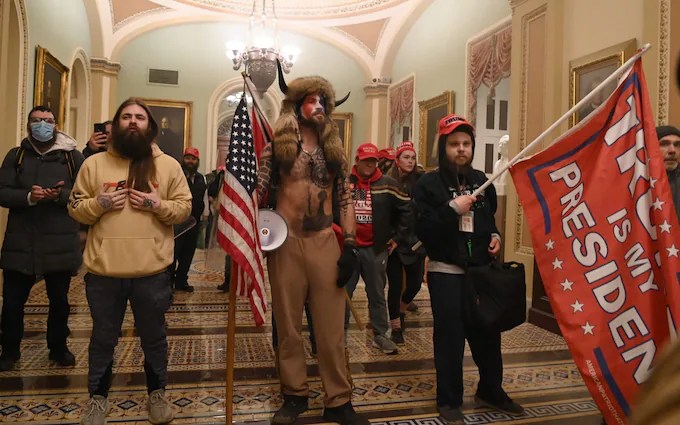
For his attempts to overturn the results in Georgia (asking officials to find 11,780 votes), Donald Trump could face charges of ten counts of racketeering, resulting in up to twenty years in prison. He could also face charges of making false statements, which could result in up to five years in prison. Trump could also face trial for mishandling classified documents by moving them from the White House to his home in Mar-A-Lago. Much like Nixon, Trump obstructed the attempts of the FBI to retrieve the files, committing the crime of espionage. Donald Trump has plead not guilty to all charges laid out against him. The majority of his trials have been postponed and will not be likely to take place before the election in November.
Aftermath
Richard Nixon
Richard Nixon’s career was never able to recover following the Watergate Scandal. By August 1974, 57% of Americans wanted him to resign, and 71% believed that he was capable of wrongdoing. This was a dramatic change of fortune following his landslide 1972 election victory. Whilst Nixon never faced any criminal trials, the public knew that he had lied to them; the evidence was undeniable. The tapes proved that Nixon was involved with the cover-up of the break-ins. He had also not followed through with several of his campaign promises. He promised to bring an end to the Vietnam War. In reality, he had prolonged it and widened its scope; bombing Cambodia and Laos as well as Vietnam. More lives were lost under his presidency than Lyndon Johnson’s. Until his death in 1994, Nixon was somewhat of a recluse. He gave other presidents some advice on foreign policy and wrote several books. However, his political career was never the same.
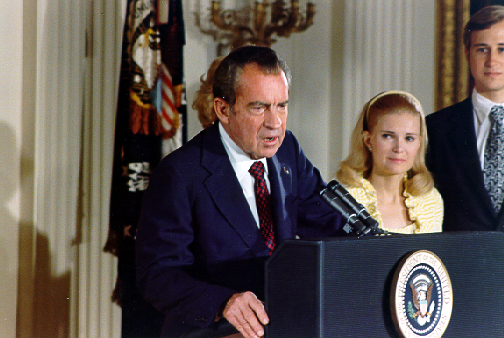
The ramifications did not just affect Nixon. Shortly after taking over the presidency, Gerald Ford pardoned Nixon in September 1974. Ford’s approval ratings plummeted shortly afterwards and he lost the 1976 election to Jimmy Carter. Today, Ford’s two years in office are largely forgotten with no legacy left behind. His humiliating defeat marked the end of the Nixon era for good.
Donald Trump
Despite all of the charges laid out against him, Trump still has an incredibly loyal fanbase who are determined to get him back in office in November. Many believe that the charges were politically motivated and that Trump was sabotaged by the Democrats. His arrest has led him becoming an anti-establishment figure. Merchandise has been made featuring his mugshot with the words never surrender underneath. Current predictions state that Trump has a 2 in 3 chance of winning the 2024 election. He is projected to win 302 electoral college votes, whereas Joe Biden is projected to win 236. Despite two impeachments and multiple criminal charges against him, Trump could make an unprecedented return to the White House.
Why can Trump make a comeback?
The big question is why has Trump succeeded where Nixon failed? How can he come back from these scandals? We live in an era of strong political polarisation, aided by social media. In the 2020’s, there is much stronger party loyalty than there was in the 1970’s. It is very rare for presidents to win landslide victories in elections, the last time being Ronald Reagan’s victory in 1984. People now vote for parties rather than people, which in the United States has serious consequences. Trump’s supporters are fuelled by their hatred for the Democrats. They are seen as ‘the enemy’, and Trump regularly added fuel to the fire. He constantly published Tweets criticising the Democrats; portraying them as enemies of the state. He portrayed liberalism as an evil force that was destroying society, and that only he could save America. Nixon also used some of this rhetoric, being the first to coin the term ‘silent majority’ in 1968. However, Nixon was speaking before the age of social media.
Many people are part of political echo chambers, where they refuse to hear the opinion of the other side. In these echo chambers, false information spreads like wildfire. People have become more extreme with their opinions, and Trump has taken advantage of that. He makes tweets and remarks that he knows will provoke those extreme reactions. His followers are disenchanted with the American political system, and Donald Trump provides them with the solutions they are looking for. He stands with the far-right, taking the Republican party to depths not even reached by Nixon. He is anti-abortion, anti-immigration, and pro-gun; everything that right-wing Americans want in a leader. He is seen to be protecting Christian values, despite rarely attending church himself. Trump supporters worship him in ways a president has never been worshipped before. No other president has had as many supporters wearing hats and t-shirts, waving flags and hanging up posters with their name all over them.
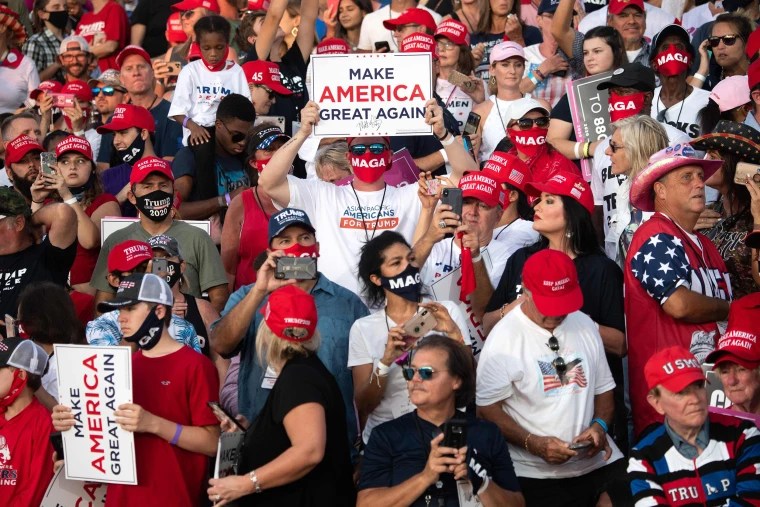
Those in Trump supporting echo chambers deeply distrust anyone associated with the Democrats, and have even turned their distrust towards ‘weak’ Republicans who do not support Trump’s actions. Many of these supporters stormed the Capitol in 2021 because they believed the election was stolen; largely thanks to Trump’s constant Tweeting about election fraud. The fact that experts have stated that he spread false information meant nothing. Trump is a product of growing political polarisation. When Nixon resigned, very few people were dedicated to one political party over the other. Many of those who voted for Nixon in 1972 voted for Johnson in 1964. Nobody believed that the Democrats were trying to ruin Nixon’s career; even those who had previously supported him could admit that what he did was wrong. Things are different now. People refuse to see what is in front of them because it does not fit their own narrative. Those who. Support Donald Trump will likely never admit that what he did was wrong. He has succeeded because America is so divided in ways that it was not 50 years ago.
Only time will tell if Trump wins the upcoming election. With the fiasco of the presidential debates, that outcome is looking increasingly likely. If he does win, democracy in America will never be the same again.
 Stateside Stories
Leave a comment