There have been many discussions in recent years about how history is distorted to suit a particular narrative. History lessons in school rarely give people the full story about a particular person or event. As a result, people have an idea about history that is not entirely accurate. In this article, I will be looking at two presidents who have largely been misrepresented in history; Lyndon Johnson and Jimmy Carter. One has been treated too kindly in the history books, the other has been treated too harshly. What people have been taught about these presidents does not cover the full scope of their policies and their personalities.
Lyndon Johnson
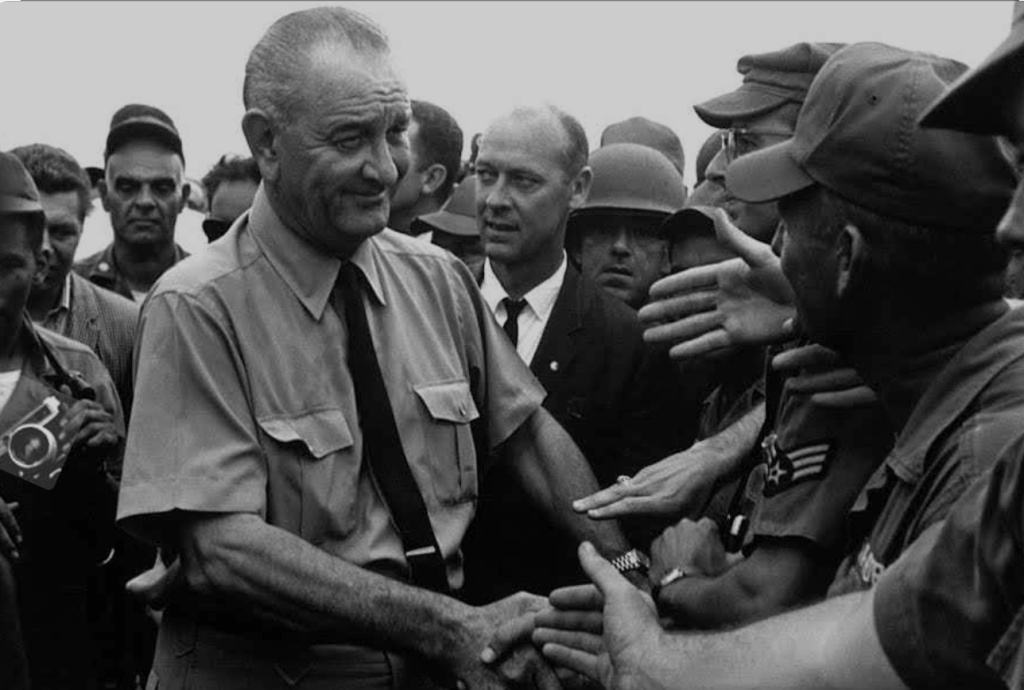
Lyndon Johnson was the 36th president of the United States, and served in office from 1963 to 1969. He is largely remembered for being the president who passed the 1964 Civil Rights Act, which marked the beginning of the end of legal racial segregation and gender discrimination in the United States in key areas of public life such as employment and the use of public facilities. The act was followed by the 1965 Voting Rights Act which abolished literacy tests and grandfather clauses that previously prohibited African Americans from voting in Southern states. Johnson is also remembered for his ‘War on Poverty’ and his ‘Great Society’ programs. These gave the US key programs such as Medicare and Medicaid that helped the poor and the elderly access healthcare. He also oversaw the expansion of higher education, a global phenomenon in the 1960’s which more women and those from impoverished backgrounds obtaining university degrees. There is no doubt that a lot of good came from Johnson’s presidency, hence why it is often remembered fondly in the history books.
However, there was a darker side to Lyndon Johnson that is not often explored. Whilst he did pass many acts and came up with many ideas that were revolutionary; he was also politically ambitious and was very accustomed to getting his own way. Johnson frequently subjected his staff to the ‘Johnson Treatment’ to get them to obey his every command. Even the new Vice President, Hubert Humphrey, was not safe from this treatment. Johnson would catch various members of staff by themselves, stand so close to them that his face was almost touching theirs, and bully them into doing what he wanted them to. Johnson was over six feet tall, and his large stature proved to be intimidating. When cornered, people felt that they could not say ‘no’ to the President. Johnson would often use this tactic when he wanted to send more troops and initiate more bombing missions in Vietnam. Even with the ‘anti-war’ movement gaining momentum, Johnson was still able to persuade his key advisors to continue with the campaign.

Johnson’s behaviour could also take a much more vulgar nature. He would frequently make references to the large size of his penis, referring to it as ‘Jumbo’. He would often compare his penis to the military; using it as a symbol of power and masculinity. When speaking to members of his staff, he would occasionally flash them, swinging his penis around and playing with it when discussing policy. He once flashed a group of journalists, suddenly unzipping his trousers and exposing his penis to them, leaving them stunned. When having a conversation with someone, he would make them follow him into the bathroom and would speak to them whilst going to the toilet, often leaving the door open so they could see him. One infamous incident occurred on board Air Force One in 1964. When answering questions about the economy, Johnson removed his shirt and trousers, and eventually his underwear. He was naked expect for a thin towel. This sort of behaviour has no place in modern society, but in the 1960’s, many kept quiet about these bizarre antics.
Johnson’s escalation of the Vietnam War and its failures are briefly taught in history lessons, but rarely explored in depth. This began with the Gulf of Tonkin incident. North Vietnamese gunboats allegedly attacked US destroyers. There was little evidence that this actually happened; but Johnson used that as an excuse to attack North Vietnam; passing a resolution that meant that he did not have to go through congress first. Maybe he wanted the prestige that came with being a wartime president. In 1965, Operation Rolling Thunder marked the beginning of bombing raids on North Vietnam. Young men all over the country were drafted, and, by 1967, there were 150,000 American casualties. Protestors began chanting “hey, hey LBJ, how many kids have you killed today?” as the average age of American soldiers was 19. The 1968 ‘Tet Offensive’ served as further embarrassment. The United States and South Vietnam were not prepared for an attack from North Vietnam. The result was hundreds of casualties and a lack of confidence in the United States’ ability to win the war. By Autumn 1968, Johnson’s handling of the Vietnam war was so disastrous that he refused to run for re-election.
Jimmy Carter
Jimmy Carter was the 39th president, and served in office from 1977 to 1981. Very little is taught about Jimmy Carter, other than the fact that he managed a failing economy and struggled to find a resolution for the Iran hostage crisis. The failing economy was something that Carter inherited, not created. Ironically, it was Johnson that plunged the nation into debt whilst waging the war in Vietnam. Increased government spending led to increased debt. The situation grew worse under Richard Nixon due to the 1973 OPEC crisis. The price of oil quadrupled, and inflation plagued the United States for years. Nixon also increased spending on the war in Vietnam and domestic social security programs in the hopes of getting re-elected in 1972.
By the time that Jimmy Carter had inherited the economy, it was in very bad shape. Unemployment and inflation were both at over 10%, largely due to Nixon’s inaction. Carter tried to sort out America’s economic woes. He created a program that would train the long-term unemployed to work in the private sector. The unemployment rate did drop slightly, by 1979 it was just over 5%; with over 9 million new jobs being created. Carter struggled to control inflation, it rose to 13% by 1979. However, inflation was a global problem that could not easily be solved. Another oil price shock occurred in 1979, with oil prices doubling. As long as oil prices were out of control, inflation would be as well.
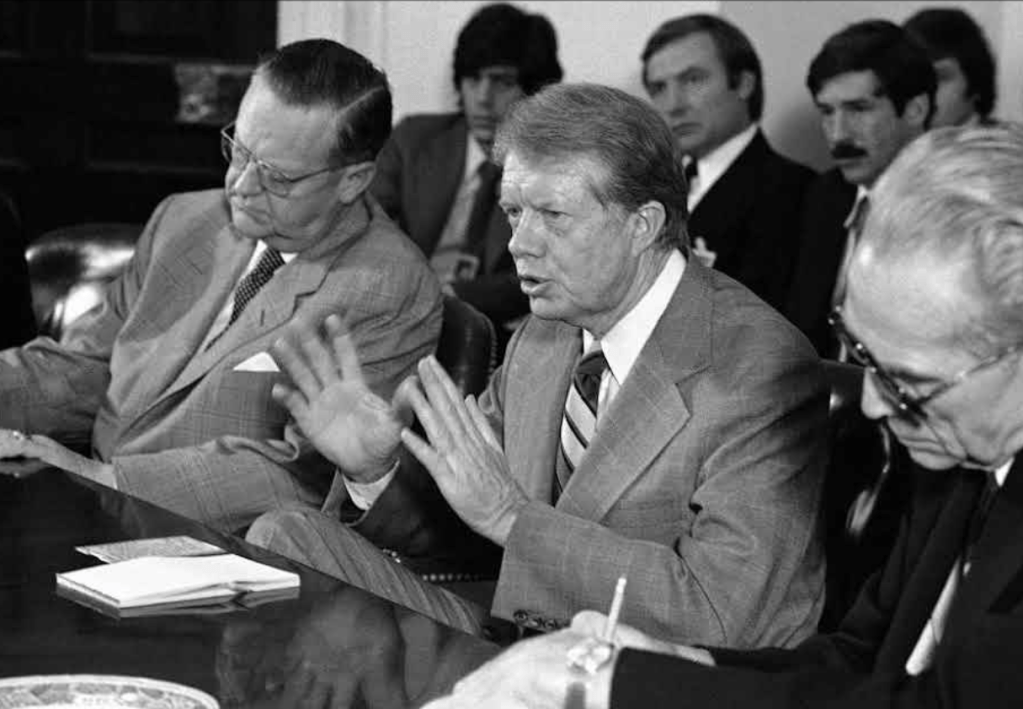
Carter began the processes of deregulation and tax cuts that Reagan is often credited for. In 1977, he introduced the first of many tax cuts for big corporations, encouraging them to set up business in the US. His process of deregulation began with the airline industry in 1978; encouraging competition between all of the different airlines and therefore economic growth. He also planned to deregulate the railways and telecommunications. Whilst Reagan is associated with deregulation; it was actually Carter who set the wheels in motion. Whilst Reagan is often credited with ‘fixing’ the economy after Carter left office, the US still suffered from economic problems for years afterwards. Reagan’s high defence spending plummeted the country into further amounts of debt; eventually hitting the one trillion mark. The economic crisis would not be completely solved until Bill Clinton, the 42nd president was in office. This was when the national debt was finally cleared, and taxes for the middle-class were not as strenuous. Six presidents oversaw the failing economy, and yet only Carter faced scrutiny for it.
Out of all the US presidents, it can be argued that Carter had the strongest moral compass. He has done a lot of humanitarian work throughout his life, including in old age. Just a few years ago, he was pictured building houses. The Iranian Hostage Crisis is one example of Carter’s humanitarianism. In 1979, sixty-six US citizens were kidnapped and held hostage in Tehran during the course of the Iranian Revolution. The Carter administration quickly placed sanctions against Iran, boycotting their oil and freezing their assets in the US. Carter wanted to engage in peaceful negotiations, but the new Iranian government refused to cooperate. It was only when Iraq invaded Iran that negotiations were finally on the table, as US-led sanctions were destroying the Iranian economy. Carter worked day and night for months to free the 54 hostages. Even after his defeat in the 1980 election, he was making phone calls and trying to negotiate with Tehran. On the 20th January 1981, a few minutes after Reagan’s inauguration, the hostages were finally released after approximately 18 months in captivity. Reagan is often credited for their release, but it was Carter who really made the difference.
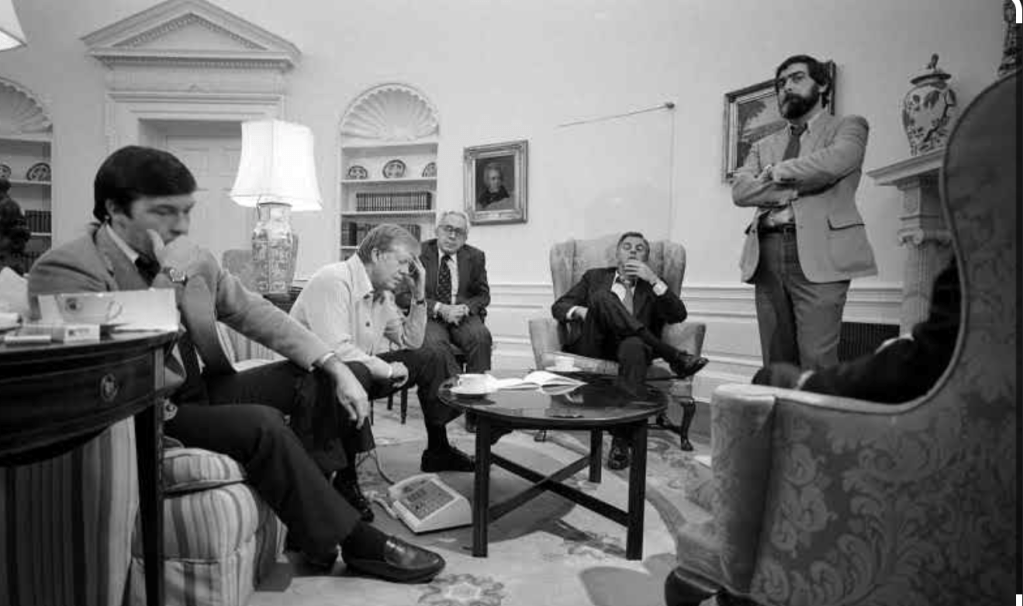
Whilst they have not been undoubtedly proven, there were rumours that Reagan’s campaign team sabotaged Carter to guarantee that Reagan would win the 1980 election. They allegedly made deals with the new Iranian government to release the hostages after the election. This has become known as the ‘October Surprise’. The deal involved the US giving arms to Iran to combat Iraq. If this was true, it would not be the last time that the Reagan administration illegally provided arms to Iran. The 1986 ‘Iran-Contra’ scandal saw them participate in similar illegal arms dealings to fund the right-wing Contras in Nicaragua. Whilst this sabotage has never been completely proven, it does offer an insight into the way that Carter’s presidency has potentially been hampered by factors out of his control.
 Stateside Stories
Leave a comment