In last week’s blog, I looked at Presidents George W. Bush and Joe Biden who are not great at public speaking. This week, I will be looking at four Presidents who were fantastic at it; Franklin Roosevelt, John Kennedy, Ronald Reagan and Barack Obama. All four of them delivered speeches that inspired, shocked and reassured Americans. For each I will be examining one iconic speech that they delivered. For Franklin Roosevelt, it is that the Day of Infamy speech that he delivered the day after Japanese forces bombed Pearl Harbour in Hawaii in 1941; bringing the United States into the Second World War. For John Kennedy, I will be looking at his We Choose to go to the Moon from 1962; where he made the prediction that the United States would send a man to the moon by the end of the 1960’s. For Ronald Reagan, I will be examining his Tear Down This Wall speech from1987. He called for the demolition of the Berlin Wall and the end of the Cold War once and for all. I will also be studying Obama’s A More Perfect Union speech from his presidential campaign in 2008; which addressed divisions that still existed in America.
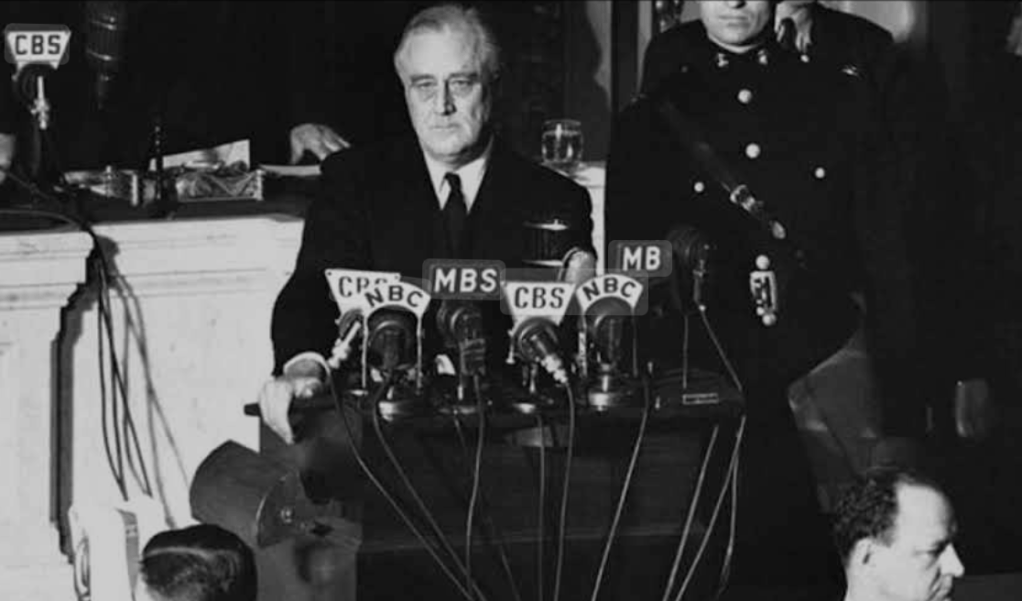
A Day of Infamy (Franklin Roosevelt, 8th December 1941)
On the 7th December 1941, Japanese Forces bombed the Pearl Harbour naval base in Oahu, Hawaii. 2,403 Americans died in the attack; it became apparent that the United States was at war with Japan. The following day, President Franklin D. Roosevelt gave a short speech that condemned the act of aggression. He described the 7th December 1941 as “a date which will live in infamy”, an expression which became famous. He stated that the attack occurred on the “American Island of Oahu, an important choice of wording as, being over 2,000 miles away from the mainland, Hawaii was often viewed as separate from the rest of the country. Roosevelt wanted to emphasise that America was under attack.
Roosevelt portrayed Japan as an aggressive and expansionist nation that presented a global threat. Due to the fact that Hawaii was almost as close to Japan as it was to the United States, Roosevelt stated that the attack “was deliberately planned many days or even weeks ago”. He wanted Americans to view the Japanese empire as cold and calculating; nobody knew their next move. He stated that Japan had already attacked other nations: Malaysia, Hong Kong, Guam and the Philippines. It had already expanded across Asia; North America was bound to be next. He finished by warning Americans that “our people, our territory, and our interests are in grave danger.” The collective pronoun ‘our’, emphasised that everybody was in peril. The United States had to declare war against Japan to ensure the safety of American citizens. The United States entered the Second World War shortly after this. Roosevelt did not live to see the end of the war, or the drastic action the United States took to make Japan surrender. The vision of the Japanese as evil people that Roosevelt laid out may have contributed to the use of atomic weapons that killed thousands. This emphasises the power that a good speech can possess, for better or for worse.
We Choose to go to the Moon (John Kennedy, 12th September 1962)
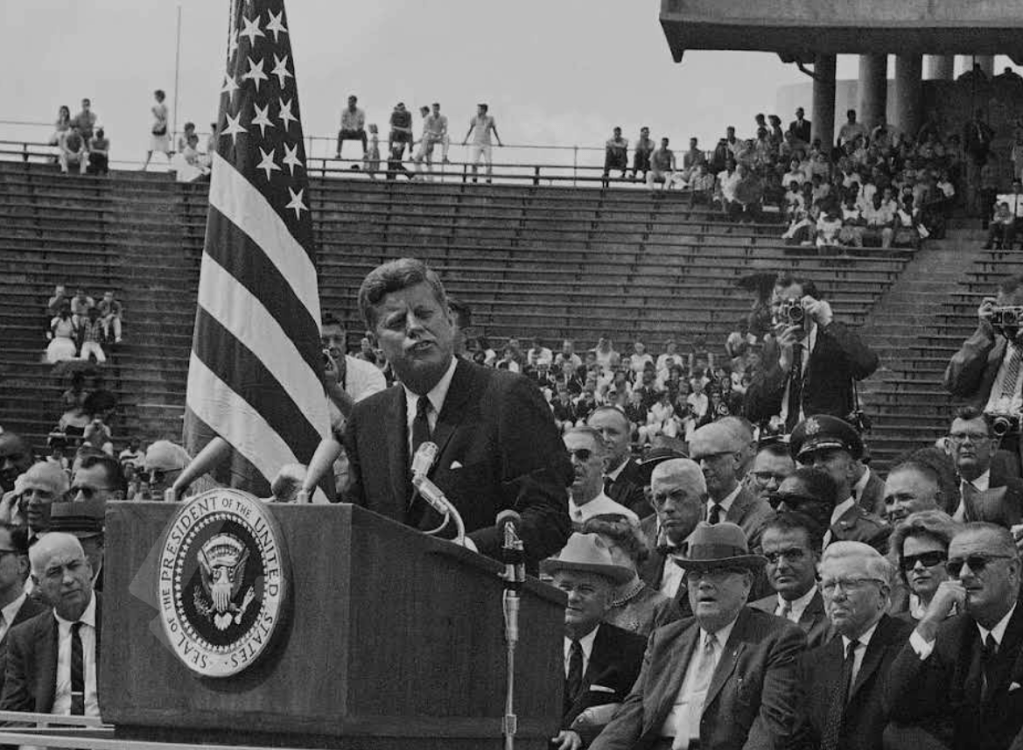
The Space Race of the 1950’s and 1960’s was a key phase of the Cold War as the United States and Soviet Union competed with each other in technological advancement and space exploration. By 1962, the Soviet Union appeared to be in the lead. In 1957, they sent the first satellite, Sputnik into space. In 1959, they made the first spacecraft that reached the surface of the moon. Their biggest triumph occurred in 1961, when Yuri Gagarin became the first man to enter space. With the Soviet Union beating the United States is every major milestone, there were fears that they could win the Space Race. There were also concerns that space could be used as a theatre of war. Whilst speaking as an honorary lecturer at Rice University in Houston, Texas, Kennedy hoped to put the fears of the American people to rest.
He acknowledged that the future was uncertain, and that the 1960’s were a “decade of hope and fear” as nobody knew what the consequences of the Cold War could be. He stated that space exploration could create “new ills” if it is decided that space should be an area of conflict. Humans had already used land, sea and the sky as theatres of war; space could be next. However, he believed that the United States needed to conquer space first, so it could become a place of peace and innovation. He gave his audience a message of hope, stating that “we will set sail on this new sea” of space. By using the collective pronoun of ‘we’, he ensured that everybody felt included. It was exciting; a new adventure.
He described space as a “new ocean”, this metaphor suggesting that space allows for exploration, as people would be entering unchartered territory. He was ambitious, and set the United States a goal that changed history. He declared that “we choose to go to the moon in this decade”. The goal for the United States to get a man on the moon first would ensure that they won the Space Race. He informs that students of Houston that their city would be the centre of this ground-breaking milestone, as the space centre was located there. He made audience feel like they were part of something; they would benefit from space exploration. He described space exploration as the “greatest adventure on which man has ever embarked”. It was worth every cent that government spent ensuring that their ambitious goal was met.
Sadly, Kennedy did not live to see Neil Armstrong step on the moon in July 1969. However, this successful moon landing remains a vital part of his legacy. His famous words of “we do these things not because they are easy, but because they are hard” remind Americans of an era that was full of hope and prosperity. This era was not long-lived; for the most part the 1960’s was full of violence, war and discontent. However, there was a brief moment in time where people were hopeful for the future, and Kennedy’s speech defines that era.
Tear Down This Wall! (Ronald Reagan, 12th June 1987)
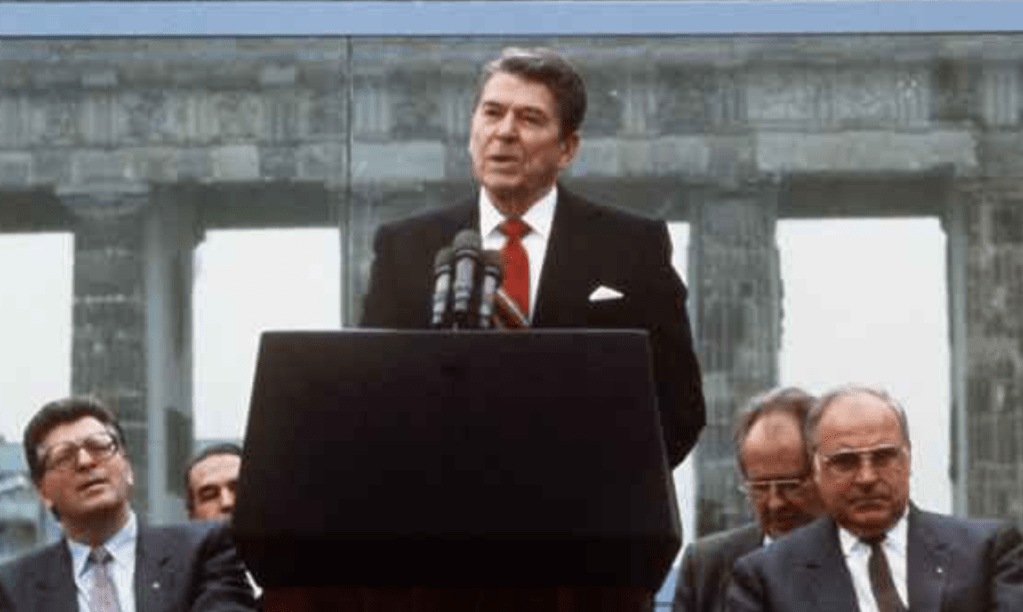
The 1980’s saw the tensions of the Cold War rise after a period of Détente in the 1970’s. People once again feared nuclear war and both the United States and the Soviet Union were behaving more unpredictably. Germany and Berlin were still split in half, and those in East Germany were becoming increasingly discontent with their quality of life. On the 750th anniversary of the founding of Berlin, Ronald Reagan gave a speech by the Brandenburg Gate. Mirroring Churchill’s Iron Curtain speech from forty years before, Reagan stated that the Berlin Wall, which was built in 1961, “divides the entire continent of Europe”. He compared it to a “scar”; a powerful metaphor which depicted the wall as an injury that has inflicted Europe for nearly three decades. As long as the wall was still standing, “every man is a German, separated from his fellow man.” This language depicted the wall as emasculating, and as something which made people feel isolated in a country that they should call home.
Reagan ended his speech with his famous exclamation “Mr Gorbachev, open this gate!” Mr Gorbachev, tear down this wall!”. Here, Reagan provided a direct challenge to the Soviet Union, and its leader Gorbachev. Things needed to change, Europe could not be divided forever. This marked the beginning of a period of cooperation between the two superpowers to end the Cold War once and for all. Less than 18 months after Reagan gave his speech, on the 9th November 1989, the Berlin Wall fell down. East and West Germans finally reunited, with some reuniting with old friends and family members that they had not seen for 28 years.
The process of reunification began in Germany, with East Germans taking part in a free and fair election in 1990 to decide the German Chancellor; their first in over four decades. East Germany became part of NATO and the country was officially reunified by 1991. The Soviet Union collapsed on Christmas Day 1991; just four years after Reagan’s speech. It was then that the Cold War was considered to be ‘over’. As we have seen recently, this consideration was premature. We once again live in a world were Russia is attempting to occupy other nations, and the United States is attempting to assert its authority over global affairs; even when this was not asked for. Maybe Reagan was wrong when he believed that the collapse of the Berlin Wall would end the Cold War.
A More Perfect Union (Barack Obama, 18th March 2008)
This entry may be controversial, as Obama was not yet the President when he delivered this speech. This speech was delivered when he was campaigning to be President in 2008. By 2008, many Americans believed that they lived in a post-racial world, where discrimination was no longer an issue. As we have seen in recent years, the United States still has a long way to go before it has true racial equality. In this speech, Obama saw racial tension as something that still affected Americans in the twenty-first century, but also as something that could be solved through unity and cooperation. He stated that racism was “a part of our union that we have yet to perfect”.
Much like John Kennedy, Obama frequently used the word ‘we’ in his speeches; making sure that everybody felt included when he was speaking. He declared that “by working together, we can heal some of our old racial scars”. He made it clear that he believed that imposing further divisions within society was not the answer. People needed to support each other for society to improve. He used the same ‘scar’ metaphor that Reagan used to represent a long-term issue that harms society. What happened in the past could still affect the present.
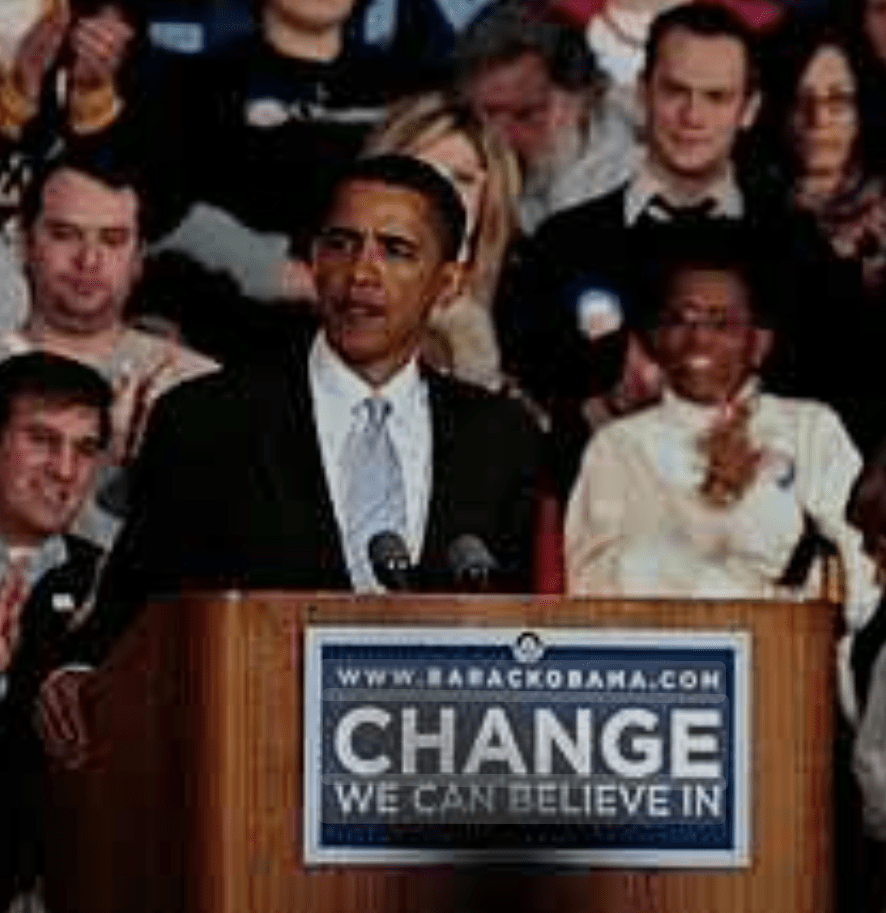
Obama also believed that cooperation among the American people was needed to solve other issues that the nation faced. By 2008, the United States was dealing with climate change, high unemployment, educational inequality and unequal access to healthcare. Obama wanted to provide Americans with a message of hope during those difficult times. He promised that “America can change, as we have seen and know”. This statement undoubtedly provided listeners with some reassurance. After a turbulent eight years under the Bush administration which saw increased conflict in the Middle East, economic strife and many Presidential gaffes, people were looking for some stability. Obama seemed like he would provide that.
Obama won the 2008 election with 365 electoral college votes and got re-elected in 2012. Unfortunately, the United States has not changed since he became President. Racial tension is still rife, the economy is still unstable and despite his best efforts, healthcare is still unaffordable and gun violence is still a problem. Of course, Obama could not predict that Donald Trump would undo many of his policies. Even if the ideas Obama promoted in his speech did not come into fruition, his words still resonate with Americans who hope that one day things will change.
 Stateside Stories
Leave a comment