When campaigning to win the Presidency, it is common for candidates to make promises that would encourage people to vote for them. These promises will vary in nature; some candidates may promise to lower unemployment, make healthcare more affordable or reform education. However, it is unfortunately common for these candidates to break these promises once they are in power. Sometimes it is unintentional; unexpected situations may emerge that mean they have no choice but to go back on their word. Other times, they may have never intended to keep their promises and only made them to get votes.
In this post, I will be looking at three presidents who made promises that they were not able to keep. The first is Woodrow Wilson, who in 1916 promised that the US would not enter the First World War. As Germany became more unpredictable and threatened the safety of US citizens, Wilson had no choice but to ask congress for a declaration of war. The second is Herbert Hoover, who in 1928 promised prosperity for all Americans. Just one year later, the Wall Street Crash happened, which led to the Great Depression. Rather than experiencing prosperity, many Americans were plunged into poverty. The third is George H. W. Bush, who made the bold statement of “read my lips… no new taxes!” during his Presidential campaign in 1988. The terrible economic situation that the US faced meant that Bush had no choice but to raise taxes, and his became the most famous broken promise in US history.
Woodrow Wilson (“He Kept us out of the War” 1916)
It may be difficult to believe today, but there was once a time when the United States did not want to get involved in the affairs of other nations. In the early twentieth century, the United States was very isolationist and did not want to take part in European affairs. Until 1917, the US took a neutral stance in the First World War. Woodrow Wilson wanted the nation to remain that way. As the former Governor of New Jersey, he was much more experienced in dealing with domestic policy than foreign policy. He was also a devout Christian and believed that God did not want him to join the war. When war broke out in 1914, the United States made it clear that it would not get involved. Whilst Europeans were ready for battle, many Americans did not want to participate. Resentment towards the British was quite high in some areas, and the last thing people wanted was to fight alongside them. For a couple of years, the war could be ignored.
However, in 1916, concerns that Germany was a threat to the United States were raised. Germany had acquired submarines and were using them to destroy not only naval ships, but also passenger ships such as the Lusitania. When the ship was sunk, 1,195 people were killed, including 128 Americans The loss of civilian life could not be ignored. However, Wilson wanted to keep his promise of not entering the war. He and his cabinet created the Sussex Pledge. This stated that the US would turn against Germany if they continued to attack unarmed passenger ships. The Pledge seemed to work, and Germany reduced its submarine activity.
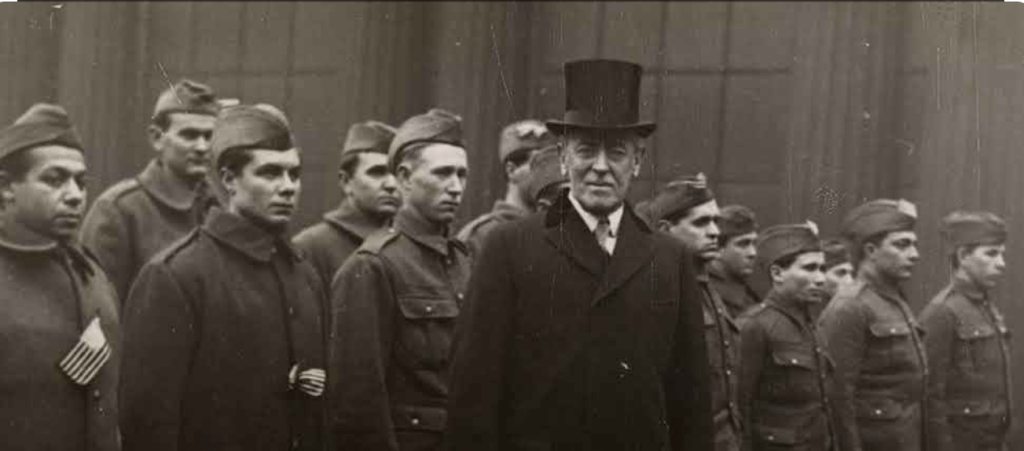
However, things dramatically changed in January 1917. Germany had discovered that the US had been sending military and financial aid to the Allies. It was decided that the US was no longer neutral, and that the Sussex Pledge was no longer valid. Germany made the decision to practise unrestricted submarine warfare, and began targeting US ships. Wilson realised that he could no longer ignore what was happening in Europe. Wilson asked congress for a declaration of war against Germany. On the 6th April 1917, the US officially entered the First World War on the side of the Allies.
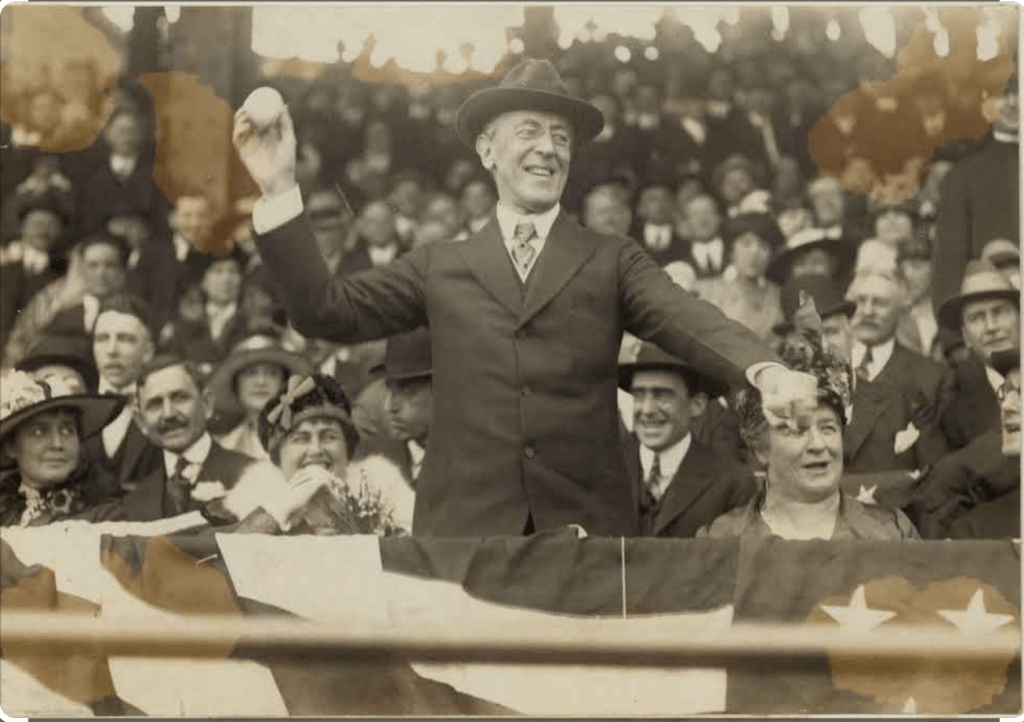
By the Armistice in 1918, 116,516 Americans had lost their lives in the war. Many more were left physically and mentally scarred by what they had experienced. The war also damaged the economy, with many veterans experiencing poverty and unemployment. Wilson’s other attempts to get involved in foreign policy were not well received. In 1919, he championed the creation of the League of Nations, a precursor to the UN. The League would encourage cooperation rather than hostility between nations. Americans were not enthusiastic about it, and the United States never joined.
Herbert Hoover (“A chicken in every pot and a car in every back yard to boot!” 1928)
The 1920’s was a decade of great change for many Americans. The social conventions of the pre-war period had been overturned, and America’s elite enjoyed attending elaborate parties, driving new cars and going on exotic holidays. It is a commonly believed myth that all Americans experienced immense prosperity during the 1920’s. Unfortunately, that is not true. Over 60% of Americans lived below the poverty line and struggled to afford basic necessities such as food, clothes and healthcare. The Great Gatsby style decadence only applied to those in the top 5% of society.
Veterans from the First World War were hit especially hard. They struggled to find employment, and were promised bonuses by the government in 1924 to help them re-integrate into American society. Despite the wide-spread poverty, many Americans lived in hope that they would experience some of the glitz and glamour that the 1920’s had to offer. When running for President in 1928, Herbert Hoover promised voters that all Americans would become prosperous. He was a firm believer in the ‘American Dream’, and believed that hard work was the key to wealth. When he won the 1928 election, many Americans believed that their fortunes would change.

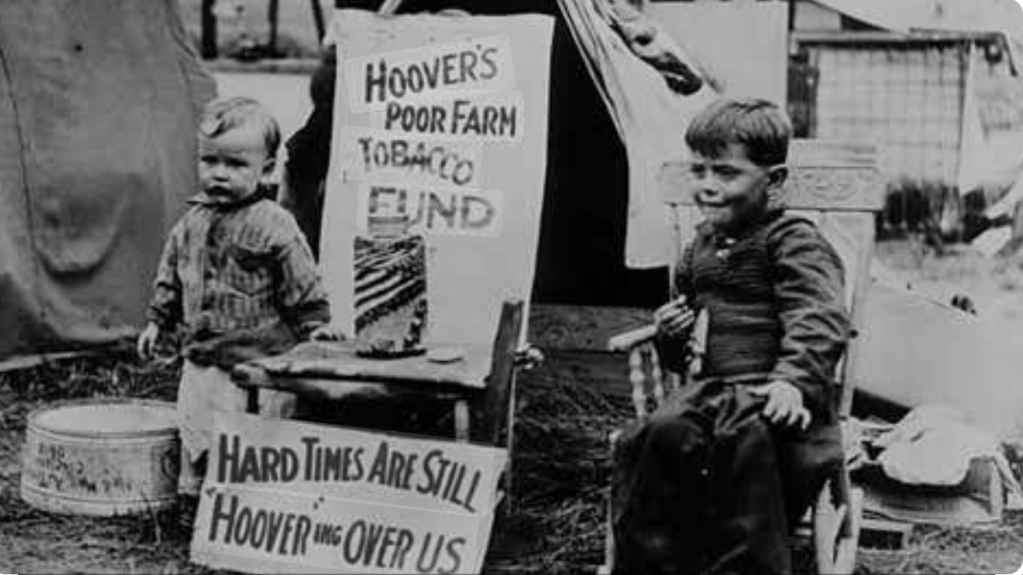
Hoover could not have predicted the events of the 29th October 1929. The stock market crashed overnight and $14 billion in stock value was lost in one day. This became known as ‘Black Tuesday’. The Wall Street Crash led to the Great Depression, which resulted in high unemployment, food shortages, inflation and worsening poverty. Quite the opposite of what Hoover had promised. Hoover was reluctant to act at first. He was a firm believer in ‘rugged individualism’ and believed private charity and the generosity of the wealthy would be enough to solve the growing economic and social issues. Shanty towns began to appear across the US. They became known as ‘Hoovervilles’; this made it clear that many blamed him for what had happened.
In 1930, Hoover realised that government intervention was needed. He passed the Hawley-Smoot Tariff Act, which increased the price of foreign goods. This was done in the hopes that people would buy American-made goods instead, boosting the economy. This act was very unpopular; the last thing people wanted was for goods to become even more unaffordable. Things reached breaking point in 1932. Many veterans who were promised bonuses in 1924 had still not received them. Marches in Washington DC were organised by veterans and their families. In May 1932, 400 veterans had gathered in the nation’s capital. By June, this number had reached 1,500. Hoover was becoming deeply unpopular.
It is believed that Hoover did too little too late. He lost the 1932 election to Franklin Roosevelt, whose New Deal did manage to alleviate some of the issues caused by the Great Depression. However, it was the Second World War that ironically managed to put an end to the high unemployment and high inflation. Rather than the prosperity that Hoover had promised, many Americans experienced hardships that have not been seen before or since. By the time Hoover left office in March 1933, 24.9% of working-age Americans were unemployed, totalling over 12 million people. His promise of wealth for all Americans was not realistic, and could never be kept even if the Wall Street Crash had not happened.
George H. W. Bush (“Read my lips… no new taxes!” 1988)
This is the most infamous broken promise in US history. It helped Bush win the 1988 election against Michael Dukakis who claimed that he would raise taxes “as a last resort”, but it was a promise that was impossible to keep. When people think of the Reagan years, they think of deregulation, privatisation, and, most importantly, tax cuts. The top tax rate dropped from 70% to 50% and there went from being fourteen different tax brackets to two. What many do not realise is that whilst the tax burden for the rich decreased, the tax burden for the middle-class increased. Income taxes actually rose, and people were fed up. Reagan’s assurance that these measures would lower the nation’s deficit fell short. His increased defence spending on projects such as ‘Star Wars’ (satellites with lasers attached that would allegedly be able to destroy nuclear missiles) pushed the national debt up to $2.8 trillion.
There was no doubt that Bush inherited an extremely unstable economy. As early as 1990 it became apparent that taxes would have to be raised to help reduce the budget deficit. Bush originally tried to reduce government spending, but that would not be enough. In 1990, the Omnibus Budget Reconciliation Act was passed. This both cut spending and increased income and payroll taxes, strengthening the burden on the middle class. Many felt betrayed by Bush’s tax increases, as he promised that nobody would have to pay more tax. The New York Post ran the scathing headline “Read my Lips… I Lied!”. Being the former head of the Central Intelligence Agency (CIA), Bush had much more experience with foreign policy than domestic policy. He did not have much experience in dealing with economic woes. He did not think about how difficult it would be for him to keep his promise.

Bush’s inability to fix the economy turned much of his voter base against him. Many voted for him because they were fed up of rising income taxes, and he promised that this would no longer happen. By 1992, many believed that Bush was a liar. Bill Clinton, his opponent in the 1992 election, frequently mentioned Bush’s broken promise. He had let the American people down. Bush lost the 1992 election to Clinton, and many believe that “Read my lips” was the main reason. Bush fell victim to the same mistake that Wilson and Hoover did; he made a promise that was impossible to keep. All three made promises that did not consider how turbulent international relations could be or how unstable the economy could be. A lot could happen in four years, and these three Presidents seemed to forget this fact when making unrealistic promises to the American people.
 Stateside Stories
Leave a comment