Earlier, this month former President Jimmy Carter celebrated his 100th birthday. He is the longest-living American President in history, having left office 43 years ago. Carter is unfairly remembered as a weak president, having inherited numerous economic issues from his predecessors that he could not solve. However, Carter also has many achievements to his name. Even into his 90’s, he was pictured building houses for the homeless in his home state of Georgia. No other president has come close to Carter in terms of humanitarianism, and it can be argued that Carter expressed many ideas that put him ahead of his time. In this article, I will talk about two achievements from when Carter was in office, and one incredible achievement from when he still worked in the Navy.
The Camp David Agreement
In the late 1970’s, tension between Isreal and Egypt concerned many world leaders. In 1977, the conservative Likud Party headed by Menachem Begin won their first-ever election. The party promised for a ‘Greater Isreal’, hoping to maintain their occupation of Gaza and the West Bank. This displeased the Egyptian President, Anwar Sadat, who wanted the boarders of Isreal to go back to how they were in 1967. However, Isreal refused to withdraw from either Gaza or the West Bank. Sadat announced on the 9th November 1977 that he was planning a trip to Jerusalem to make his demands heard. With both countries trapped in a political stalemate, there appeared to be no hope of progress.
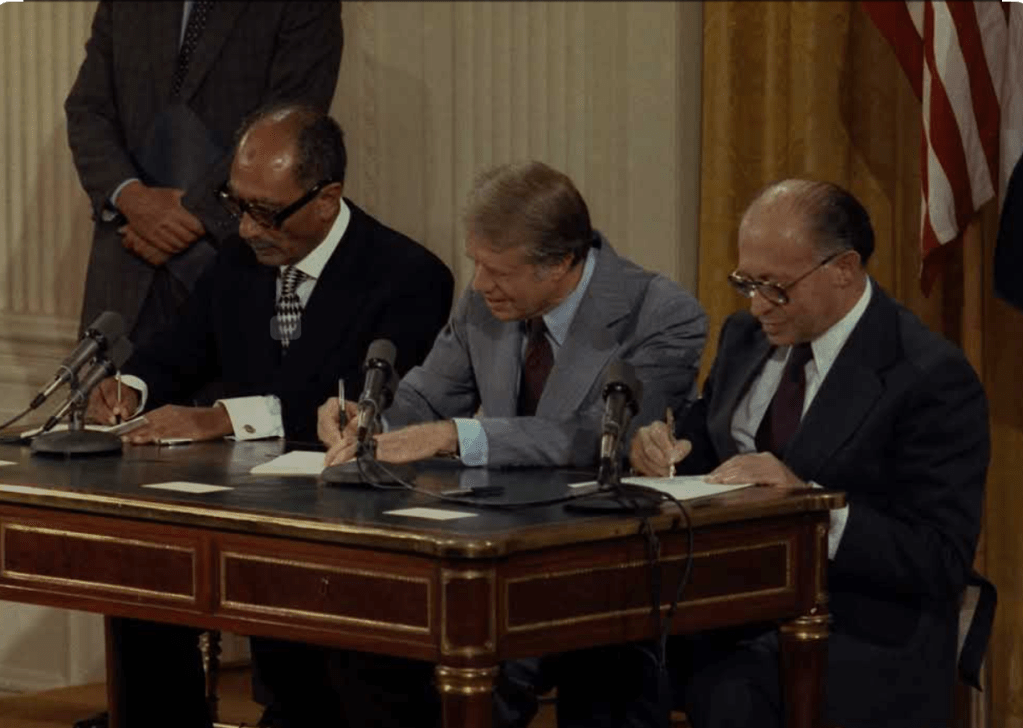
Jimmy Carter deeply wanted a solution to this problem. As a humanitarian, Carter placed an emphasis on diplomatic conflict resolution. He arranged the Camp David Summit which was held from the 5th September to the 17th September 1978. In this summit, Carter made both parties agree to a peace treaty. In early 1979, plans were made to ratify this treaty. Begin expressed some reluctance as he was concerned about Isreal’s oil supply. After Carter guaranteed that it would not be negatively affected, Begin agreed to sign the peace treaty on the 13th March 1979. Sadat agreed to sign the treaty on the 26th March.
Carter’s involvement in Egypt and Isreal’s conflict was a rare example of a president becoming deeply concerned about a single foreign policy issue. Even more rare was a president advocating for a peaceful, diplomatic solution rather than choosing to send troops to solve the issue. Carter did not ‘pick a side’ like most presidents have done when two countries have entered conflict. Instead, he took a balanced, pragmatic approach to the issue, and it paid off.
The Environment
When it came to the environment, Carter was ahead of his time. As early as 1977, he was warning the public and other politicians about the disastrous effects climate change could have on our planet. During his presidency, Carter signed 14 major pieces of environmental legislation.He created the Department of Energy which funded alternative sources of power such as solar and wind power. In 1979, Carter installed 32 solar panels on the West Wing of the White House. These were taken down by Ronald Reagan, but eventually reinstalled by Barack Obama. He also created the ‘superfund’ which managed the cleanup of hazardous materials and toxic waste on America’s waterways.

Carter wanted to protect American wildlife from housing and road development. In 1978, he declared that 56 million acres of land were protected by the 1906 Antiquities Act enacted by Theodore Roosevelt, another environmentalist. This act provided legal protection for areas that were of historical or scientific interest. Alaska was the focus of Carter’s efforts. He signed into law the Alaska National Interest Lands Conservation Act (ANILCA). This ensured that over 100 million acres of land in Alaska was protected. This was vital as Alaska was falling victim to deforestation, oil drilling and animal poaching. By protecting so much land, Carter was ensuring that Alaska’s wilderness would survive.
Alaska was not the only state to receive help from Carter. In Georgia, the Chattahoochee River National Recreation Area was established in 1978. It allowed people who lived in urban areas to participate in a number of outdoor activities such as hiking, fishing and sailing. In California, Carter protected the Redwood Forest from deforestation. Whilst Carter’s ideas were deeply unpopular among fellow congressmen, there is no doubt that he has done a lot to help the environment. Over time, his ideas have gone from being hated to being celebrated, as he was the first president to seriously address climate change.
Nuclear Cleanup in Canada
This achievement occurred 25 years before Carter became the president, but is incredible and little-spoken about. In December 1952, a nuclear reactor in Chalk River, near Ottawa in Canada experienced a meltdown after multiple fuel rods ruptured. It was the first ever incident of its kind. Carter was a member of the US Navy during this time, and was part of the US Atomic Energy Commission. He and a few others were tasked with disposing of the 4.5 million litres of radioactive water that had filled up in the reactor’s basement, and with preventing a catastrophic meltdown. They were lowered into the reactor to shut it down, take apart the ruptured fuel rods and replace them.

Due to the extremely high levels of radiation that the men were being exposed to, they were only allowed in the reactor for 90 seconds each. Even this short exposure time could have been harmful to their health. Carter’s urine was radioactive for 6 months afterwards, and he was told that he might not be able to have children. The information surrounding this incident has been kept classified for several decades. This early example demonstrated the fact that Carter was not afraid to take risks for a wider cause.
 Stateside Stories
Leave a comment