In the twenty-first century, it is very difficult to go missing. In the Western world, the majority of people own a smart phone that can pinpoint their exact location. CCTV cameras have been installed on many buildings, capturing people as they walk past. Credit card activity can be used to provide a rough estimate of where somebody was last seen. However, there used to be a time when people would vanish completely. Nobody would ever find out what really happened to them and they would never be heard from again. This was especially the case in the United States. It is a very vast country, and states would not frequently communicate with each other; finding somebody would be very difficult. In this article, I will be looking at four examples of people who vanished without a trace. Their fates have been unknown, and only reduced to speculation. Decades on, all of these cases are still widely spoken, with people often producing their own theories as to what really happened.
The Escape from Alcatraz (1962)
Located in San Francisco Bay, Alcatraz became a high-security prison in 1934. Located on a small island nearly two kilometres away from land, it is known to be nearly impossible to escape. Dangerous prisoners who had histories of escape attempts were often sent there. Those that have tried to escape have never survived. This did not stop three inmates from attempting to escape on the 11th June 1962. Frank Morris was a prolific bank robber who frequently tried to escape from other prisons. He was sent to Alcatraz in June 1960. Brothers John and Clarence Algin were also bank robbers who arrived at Alcatraz in early 1961. They were placed in cells near Morris’s, and the three of them plotted their escape.
Morris was very intelligent and was the mastermind behind the planned escape. The men spent six months preparing. They noticed the ventilation cover in the wall of their cells. They used instruments such as saw blades to make the holes left by these covers large enough for a person to fit through. Objects such as suitcases were used to cover these holes from prison guards. On the 11th June, this preparation was complete. The trio broke out during the night, leaving papier-mâchè dummies with glued-on hair on their beds. The group had a complicated escape route ahead of them. After successfully climbing through the holes they made in the wall, they had to scale the prison walls, dropping fifteen meters to the ground below. They then cut through a barbed-wire fence and slid down an embankment to make it to the water. What happened after this is unknown. A search was called for the men on the 12th June, with the FBI quickly getting involved. Some debris was found in the water. Some pieces of wood and rubber were found, suggesting that the men made a sort of raft to reach the mainland. A homemade life jacket was also found. However, Morris and the Algin brothers were never found; dead or alive.
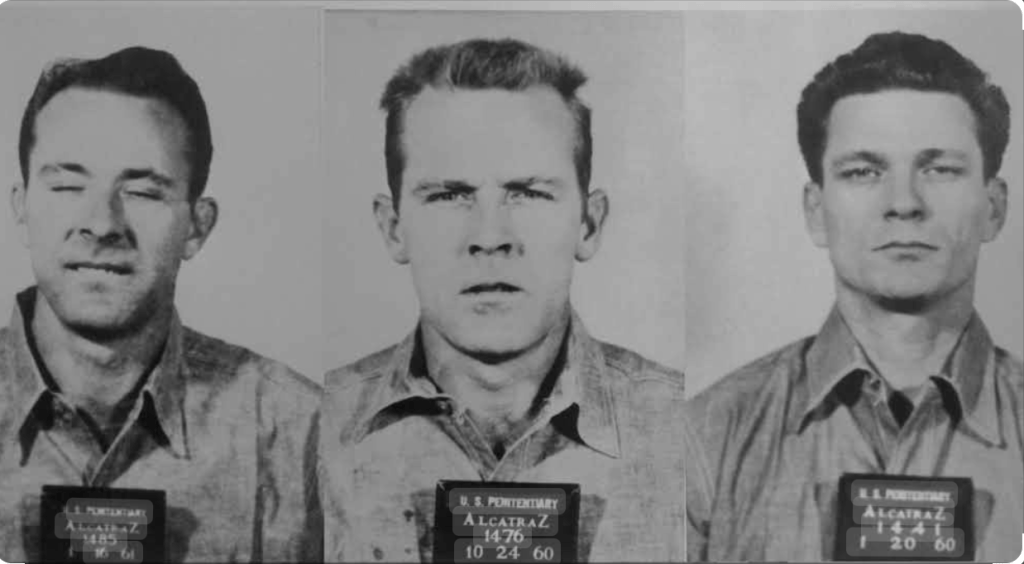
The most common theory is that the trio all drowned whilst trying to escape; a fate which had befallen many men before them. However, their bodies never washed up on shore, so this theory has never been proven. Theories that the men made it onto land and began new lives have also been impossible to prove. Family members have not seen them, and despite their mugshots being circulated across San Francisco, nobody ever came forward to report sightings of them. After seventeen years of investigation, the FBI closed the case on New Year’s Eve 1979. Alcatraz permanently ceased operations in 1963, but remains a popular tourist destination to this day. People can go on boat rides near the prison, where a guide will inform them of its history; the escape attempt and disappearance of Morris and the Algins always being mentioned. In 1979, their story became the subject of a successful Hollywood movie, with Clint Eastwood playing Morris. Decades after the case closed, this story still intrigued.
Jimmy Hoffa (1975)
Jimmy Hoffa was the President of the International Brotherhood of Teamsters from 1957 to 1971. As the leader of America’s largest union organisation, he possessed a lot power, and he did not use it wisely. In 1967, he was sentenced to thirteen years in prison for crimes such as jury-tampering, mail fraud and bribery. He only served for four years before being pardoned by President Richard Nixon. However, he was not allowed participate in any union activity until 1980. Hoffa was not well-liked. His criminal misdeed meant that he had a lot of powerful enemies. He also did not adapt to civilian life well. He was known amongst his unfortunate neighbours as a bully who hated not having his own way.
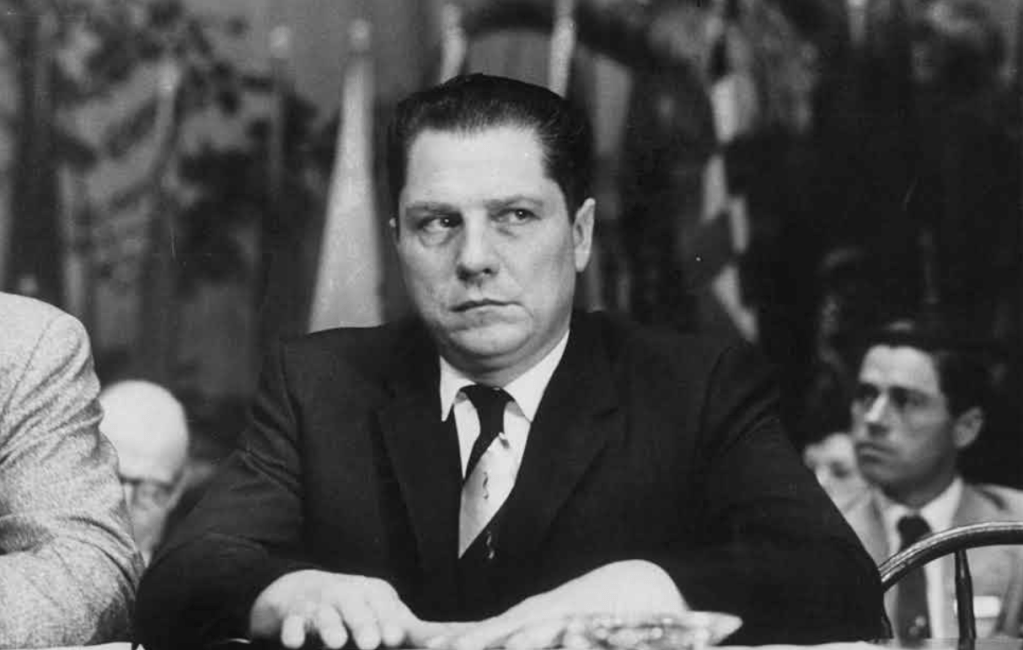
On the 30th July 1975, Hoffa was due to meet Anthony Provenzano and Anthony Giacalone at a restaurant in Blooming Fields, which was near Detroit. Hoffa contacted his wife, telling her that the two men had stood him up. That was the last time that anyone had heard from him. His car was later discovered abandoned near the restaurant, and it was revealed that two weeks before Hoffa disappeared, hundreds of millions of dollars had been cleared from the Teamster’s pension funds. The most common theory was that Hoffa was murdered, most likely by the two men that he had planned to meet. However, as his body was never found, they could not be charged. Hoffa was officially declared dead in 1982, seven years after he was last seen. His son, James P. Hoffa, believed that his father was assassinated. However, nothing has ever been proven.
D. B Cooper (1971)
On the 24th November 1971, a man registered under the fake name Dan Cooper boarded Northwest Orient Airlines Flight 305 at Portland in Oregon. He was described as being in his forties, tall, and wearing a suit. At approximately three in the afternoon, Cooper passed a note to a stewardess stating that he had a bomb with him. At his instruction, the stewardess sat with him and passed a message to the pilot that demanded four parachutes and $200,000 in $20 bills. The plane arrived in its intended destination of Seattle. The thirty-six passengers on board the flight were free to go. The pilots and crew were not. They re-boarded the plane, bound for Mexico City. At Cooper’s instruction, the plane’s altitude was always below 10,000 feet. As the plane passed over Reno, Nevada at eight in the evening, Cooper took the money and a parachute and jumped out of the plane.
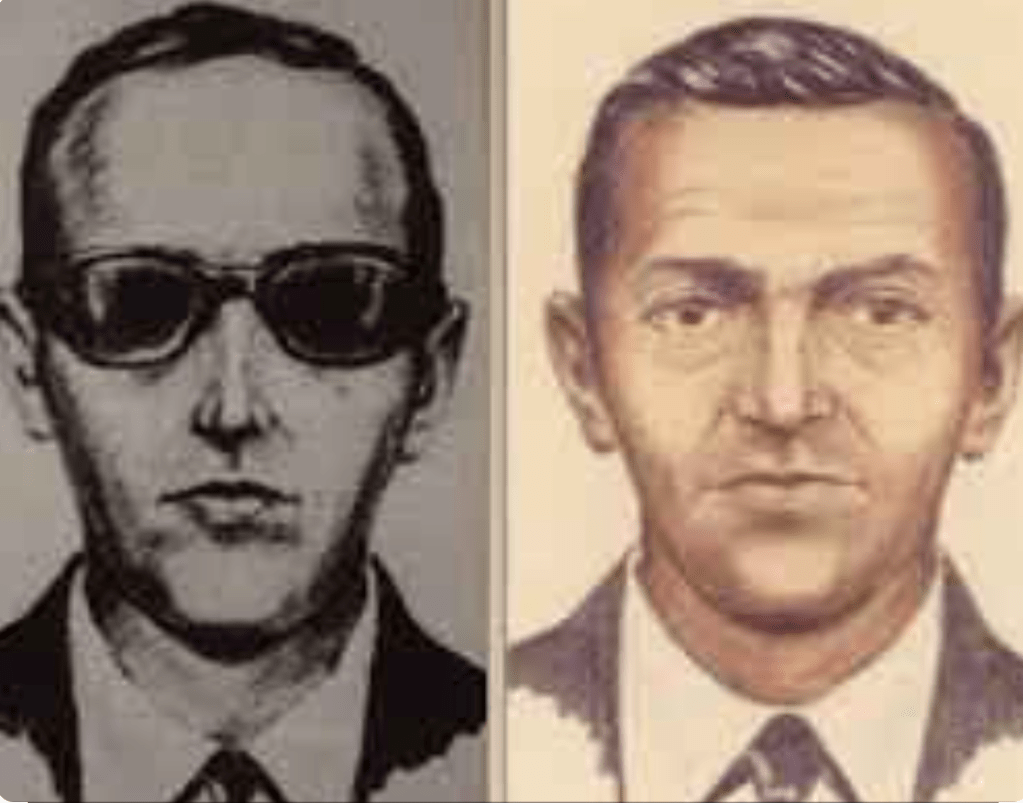
A manhunt was conducted, with the FBI quickly getting involved. 800 suspects were interviewed between 1971 and 1976, but with no success. A man called Richard McCoy was the main suspect for a while. He had been arrested for a plane hijacking a few months after D B Cooper’s disappearance. However, he did not match the physical description given by the flight crew. In 1980, a breakthrough was made when investigators found a package containing $5,800. The money was old and damaged, making people believe that it was it was the money given to Cooper in 1971. However, Cooper himself was never seen again and the FBI closed the case in 2016, after forty-five years of fruitless searches. The most widely believed theory was the Cooper did not survive the jump. He would have landed in a large woodland, and may have been caught in a tree. Even if Cooper had survived and started a new life, it is likely that in the fifty-three years since the hijacking, he has passed away from old age; finding him now would be impossible.
Ambrose Bierce (1913)
Ambrose Bierce was a very prominent figure in American literature in the late nineteenth and early twentieth centuries. He fought in the American Civil War on the side of the Union. After sustaining a serious injury in battle in 1864, Bierce retired from the army and turned his attention to writing. His Civil War combat influenced much of his work. In 1889, his short story Chickamauga was set in a woodland that has haunted by the ghosts of Civil War soldiers. The story was told through the perspective of a deaf-mute boy, making it especially eerie as these ghosts were completely silent when they should have been making noise. Bierce is recognised as an important gothic writing, and his work is still studied today.
Bierce was known for writing ‘weird tales’, and his life became one. In 1913, seventy-one year-old Bierce announced to his friends that he would travel to Mexico to observe the Civil War led by the revolutionary Pancho Villa. He travelled with the rebel troops and observed the battle of Ojinaga. He wrote to friends whilst there, one of his final letters stating that he may be “shot to rags”, but that it was better than dying of “old age, disease or falling down the cellar stairs”. Shortly afterwards, he vanished. Nobody ever heard from him again. Some believe that he was killed whilst observing the battle of Ojinaga. Others believed that he was killed by Villa himself. Bierce was declared dead in January 1914, but his body was never found.

Over a century after his disappearance, Bierce is still incredibly influential. He has been referenced in popular culture. In 1964, an episode of The Twilight Zone was based on one of his stories, An Occurrence at Owl Creek. Many credit him as being one of the pioneers of surrealist fiction, and his work has inspired countless other authors.
 Stateside Stories
Leave a comment