On the 17th July 1981, a tea dance was being held at the Hyatt Regency Hotel in Kansas City. Tea dances were regular events at the hotel, and were always well-attended. People would participate in the dances and watch them from the walkways on the second and fourth floors. These events were always jolly as people enjoyed the light-hearted entertainment. These events were so popular that the hotel would often be crowded, and the walkways would be congested as so many people stood on them. None of this appeared to be a problem though. After all, the hotel was newly built and the walkways appeared to be strong and sturdy. Everything seemed fine.
The Hyatt Regency hotel had not been in Kansas City for long. It opened in July 1980, and was a source of pride for the city. It was 40 stories-high and boasted a massive atrium which could be used to host conferences and events. The design seemed very futuristic as the hotel was mainly constructed out of metal and glass. There were some problems with the construction of the hotel. There was a setback when the roof of the hotel collapsed and had to be replaced. This obvious indication that the hotel may not have been structurally sound was quickly brushed under the carpet. When the hotel opened in 1980, very few people knew about this worrying occurrence.
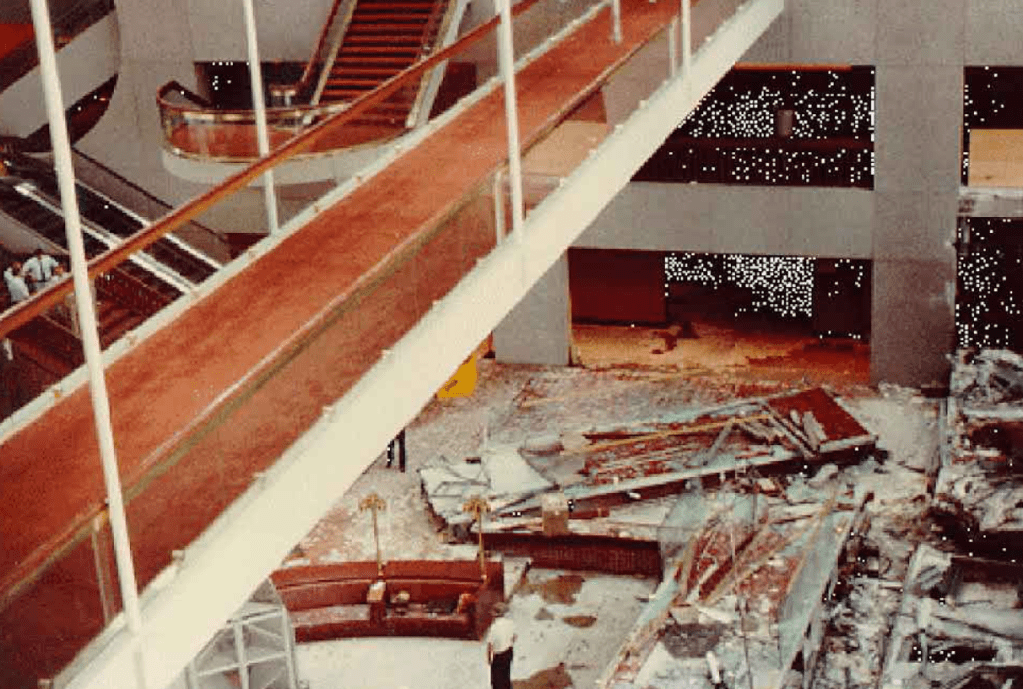
During its first year of operation, the hotel was a source of great excitement. It was one of the tallest buildings in Kansas City at the time, and people loved the fact that second and fourth floor walkways gave them a perfect view of the atrium. The walkways dangled downwards, with the fourth floor walkway being right on top of the second floor one. In July 1981, 1,600 people gathered in the hotel to watch the tea dance which was being filmed. They filled the lobby beyond capacity, and many stood on the walkways to get the best view of the action below. Everything seemed normal.
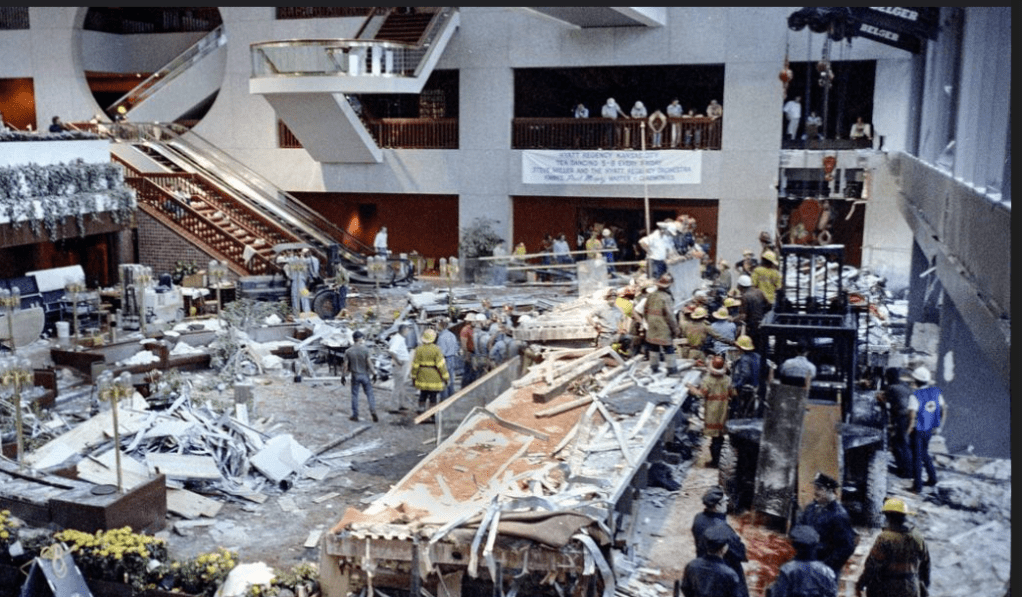
Suddenly, a loud popping sound was heard just after 7pm. Seconds later, the fourth floor walkway gave way. It fell onto the second floor walkway, which in turn collapsed. Both walkways crashed down onto the lobby below. This event happened in less than a minute, and many did not have time to react. Many people were killed instantly, and others were trapped in the wreckage. Emergency services soon arrived and began the complicated rescue operation, which took around 14 hours. Things were made worse by the fact that all of the dust from the collapsed walkways set the sprinkler system off, flooding the lobby with water.
Cranes were used to lift heavy sections of walkways, and some people could only be freed if on-site amputations were performed. Sometimes, the bodies of dead victims had to be dismembered so that rescuers could reach alive victims that were trapped beneath them. Overall, 114 people were killed and over 200 were injured. Many of these injuries were life-changing. At the time, it was the deadliest building collapse in US history.
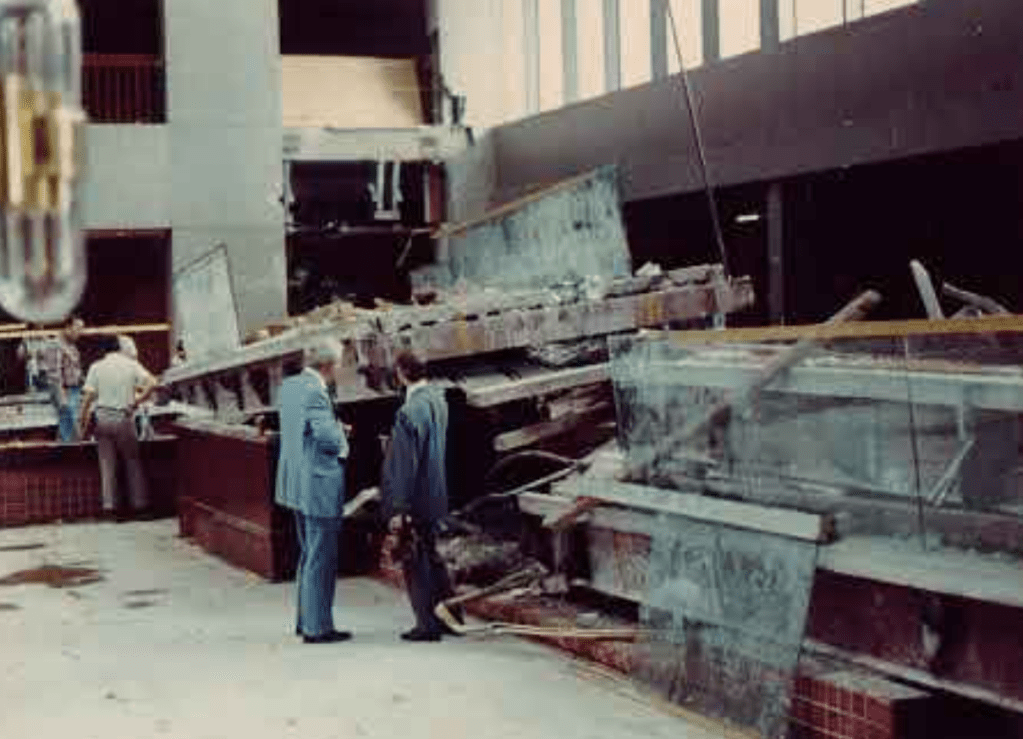
An investigation quickly uncovered a massive mistake in the building process. Rather than hanging both walkways on one long rod, two short rods were used instead. This meant that the beams of the fourth floor walkway had to support the weight of both the fourth and second floor walkways, double the load that they were meant to support. Eventually, the stress became too much. The beams could no longer support all of this weight and gave way, causing both walkways to collapse. A culture of negligance was also uncovered. Details about the construction of the building were often held over the phone than in person. Basic sketches were passed off as final drawings.
Both the engineering company and construction company relied on the other to check that the building was actually safe. Nobody took any responsibility to ensure that the building would be safe for people to venture inside. Whilst nobody faced any criminal charges, the engineering company lost its license. The hotel owners were forced to pay $140 million in damages. The hotel remained closed for several months, but eventually re-opened and became a Sheraton Hotel. A single walkway was installed, and was supported by columns rather than box-beams and rods. Today, this disaster serves as a case study for engineering students, teaching them that mistakes can have catastrophic consequences.
 Stateside Stories
Leave a comment