60 years ago today, civil rights leader Malcolm X was assassinated while speaking at a OAAU rally in Harlem, New York. His wife and children were in the crowd at the time he was killed, and it is still unknown who was really behind it. Malcom X became a very controversial figure in the Civil Rights Movement, often being negatively compared to Martin Luther King. However, it is still important that we learn about him, as his beliefs demonstrated how damaging systematic racism in the US was during the Jim Crow era, and how determined many people were to overthrow this racist system.
Malcolm X knew perfectly just how deeply racism was ingrained in US society. When he was 3, his house was burned down by a white supremacist group. When he was 6, his father was murdered by members of the KKK. After the death of his father, Malcolm X’s family struggled financially and had to rely on public assistance. Eventually, his mother was hospitalised with severe mental illness, and Malcolm and his siblings were placed in foster care. Malcolm spent his teenage years experiencing multiple run-ins with the law, and in 1946 was handed an 8 to 10-year prison sentence for breaking and entering, and possession of a firearm.
Whilst in prison, he converted to the Nation of Islam and became Malcolm X in 1952. After being released on parole, he began attending NOI meetings in Detroit and formed a friendship with Elijah Muhammad. The pair managed to triple the membership of the NOI in a year, and Malcolm X was appointed as Assistant Minister. Malcolm X promoted the idea of black nationalism, which promoted racial pride and self-sufficiency among members of the African American community. He believed that African Americans should not rely on white people for help, as most of white people hold racial prejudices. This view seems extreme, but he was speaking during the Jim Crow era, where racism was law. Even in states that were not under Jim Crow law, de facto racial segregation still existed in areas such as housing and employment. The US ran on a system of white supremacy, and lots of people grew frustrated at this.
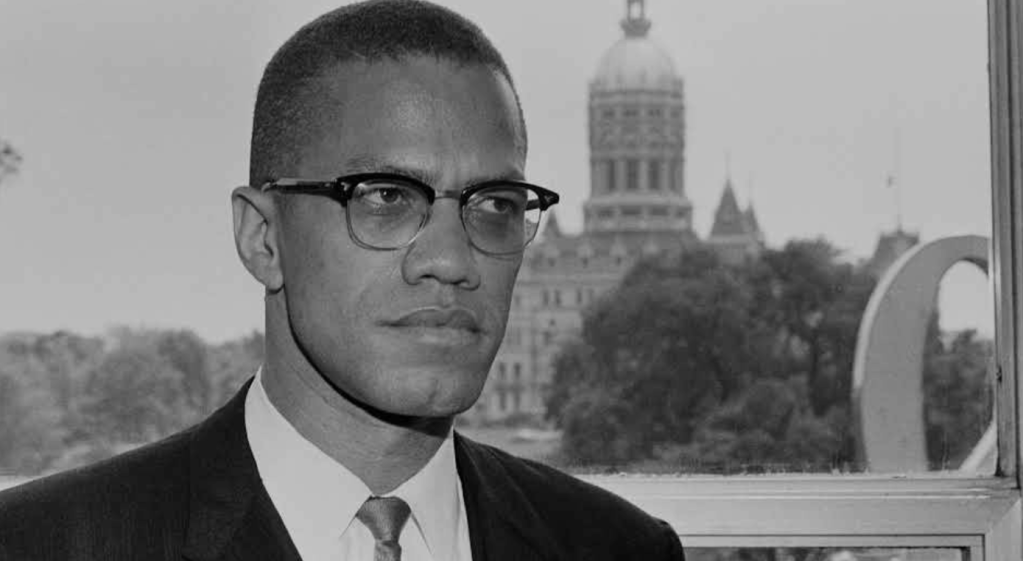
Malcolm X quickly gained a reputation for being an intelligent and charismatic speaker, channelling the feelings of anger that many felt by the 1950’s. He said that African Americans should fight for equal rights ‘by any means necessary’, contrasting the non-violence that Martin Luther King championed. This made him a much more polarising figure that King, especially among white Americans. Whilst King believed that everyone should work together to challenge racism, Malcolm X was committed to his beliefs about black seperatism. Time magazine even referred to him as a ‘demagougue’ who promoted hatred. However, many loved him, especially those in the North who knew that racism would not come to end even if the Jim Crow laws were repealed.
Malcolm X did not just speak in the US. In 1964 he arrived in the UK, speaking in Oxford, London, Birmingham and Manchester. Most notably, he visited Smethwick in the West Midlands in 1965. Smethwick was at the centre of a lot of racial tension. Conservative MP and outspoken racist Peter Griffiths was leading a campaign to prohibit the sale of houses to non-white families. Malcolm spoke to the residents of Marshall Street, where the ban would take place. Many non-white residents spoke about their poor treatment and the racism that they faced on a daily basis. His visit exposed the discrimination that took place in the UK, shattering the myth that racism has not been a big problem here.
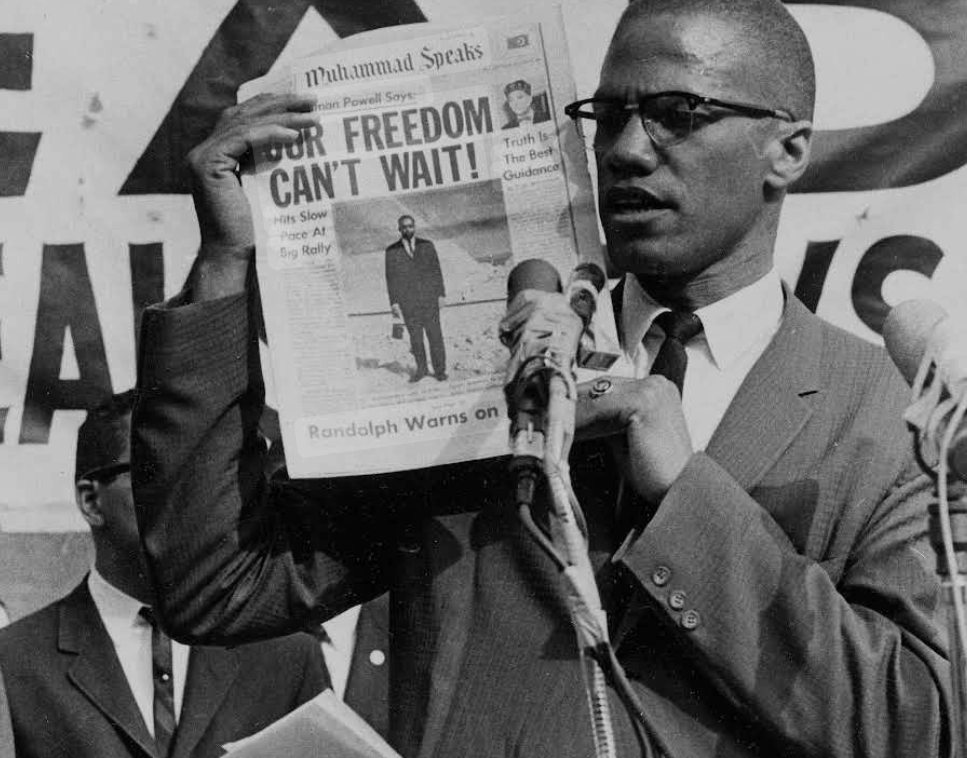
Back in the US, the friendship between Malcolm and Elijah Muhammad had become increasingly strained. Malcolm wanted the NOI to become more involved in the nation-wide civil rights protests, whereas Muhammad did not. Things came to a head in 1963 when Malcolm X described the assassination of John Kennedy as ‘chickens coming home to roost’, suggesting that people should expect acts of violence to emerge in a naturally violent society. Muhammad was enraged by this comment, and the pair would sever ties after Malcom X returned from Mecca in 1964. After his departure from the organisation, members would send him death threats and plot to commit violent acts against him. Malcolm X became closely aligned with the Student Non-Violent Coordinating Committee (SNCC), whose members included future Black Power activist Stokely Carmichael. Malcolm also founded the Organisation of Afro-American Unity (OAAU), which wanted to unite African Americans with people in Africa.
On the 21st February 1965, Malcolm X was giving a talk at the Audubon Ballroom in Washington Heights. Whilst speaking, he was shoot multiple times by three men. He was killed almost instantly. He was 39-years-old. His death came as a massive shock to the American people, with Martin Luther King called his death “a great tragedy”. Three men were convicted for his murder: Thomas Hagan, Norman Butler and and Thomas Johnson. Hagan stated that Butler and Johnson were not involved. Both men also protested their innocence, but were imprisoned anyway. They were finally released in 2021 after it was revealed that police corruption and witness intimidation played roles in their convictions.

Malcolm X was inspirational for many. Whilst many have argued that his ideas were too radical and even anti-white, it is important to remember the context in which he was speaking. The US had a strictly-upheld racist system, in which African Africans were treated like second class citizens in their daily lives. They were placed in inferior housing, their children were sent to inferior schools, and police brutality was commonplace. Even in 2025, the US still has problems with racism. African Americans are still subjected to random stop-and-searches, face wrongful convictions, are far more likely to be sentenced to death than white people, and face brutality by members of law enforcement. Whilst Jim Crow got repealed with the 1964 Civil Rights Act, it did not mark the end of racism, despite what school may teach you. Many of the problems that Malcolm X was referring to still exist 60 years on.
 Stateside Stories
Leave a comment